
Why Are Rankings Different On Semrush Than Ahrefs Explained
Why Are Rankings Different On Semrush Than Ahrefs stays a common question among website owners tracking identical keywords. That difference does not indicate that either platform is broken. Each service gathers, processes, and updates search data independently.
What Businesses Should Know about Ahrefs vs Semrush Ranking Differences
Differences may reflect the keyword database, search location, device, tracked URL, or Google SERP features. Update timing also matters in real-world use. Rankings may change between database refreshes, allowing tools to capture separate results.
Ahrefs is widely known for backlink analysis, keyword research, site audits, and rank tracking. Semrush covers these areas and supports PPC, content marketing, local SEO, social media, and advertising analysis. Therefore, an SEO tools comparison is helpful only when it reflects your goals.
One 2025 comparison found no universal winner. The right choice depends on your workflow and priorities. Anatoly Zadorozhnyy has assisted businesses improve organic rankings and qualified search traffic since 2008. His affordable SEO services are available through www.affordableseoexpert.com in many cases.
Key Takeaways
- Semrush and Ahrefs work with independent data systems.
- Ranking differences can help to result from location, device, and search settings.
- Keyword databases and update schedules affect indicated positions.
- SERP features can change how a ranking appears in each tool.
- Ahrefs and Semrush serve separate SEO and marketing needs.
- No single platform is the best choice for every business in real-world use.
Why Are Rankings Different On Semrush Than Ahrefs: A Practical Guide
Semrush and Ahrefs estimate rankings from stored search results. Each platform collects pages, matches keywords with ranking URLs, and measures visibility. Neither platform controls Google’s live findings webpage, so each position reflects a database observation rather than a guaranteed result.
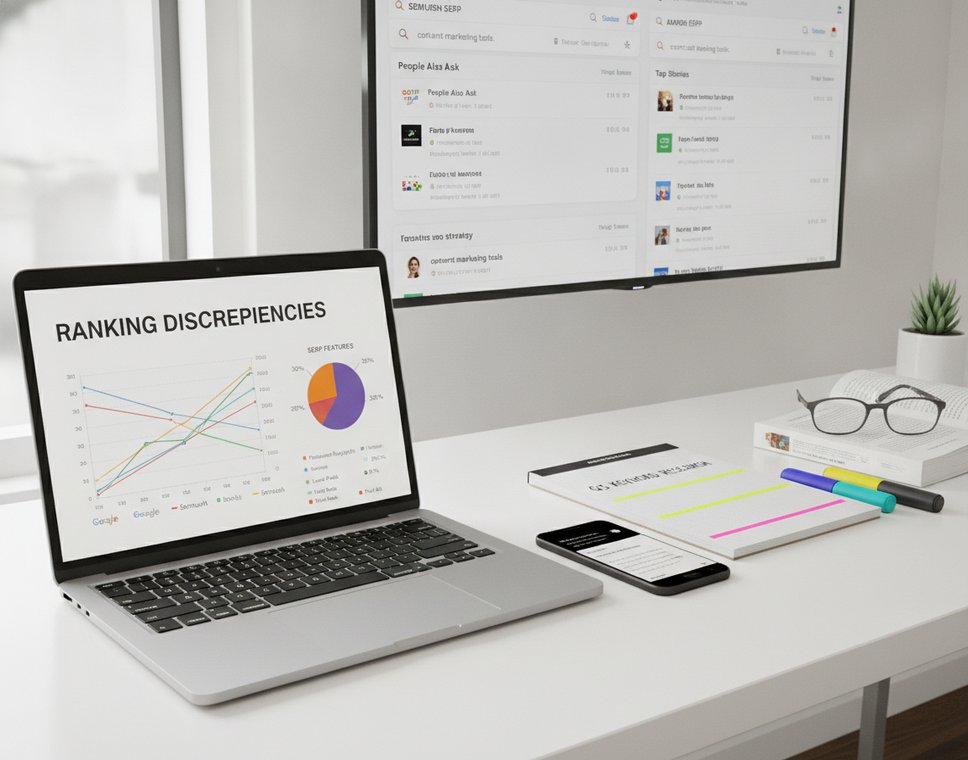
These Ranking discrepancies arise when platforms work with distinct search records or update them at different times. Semrush Position Tracking can help to record paid and organic positions through daily updates. Ahrefs Rank Tracker commonly applies weekly updates, while daily updates can require an added project charge.
 Why Ahrefs Asks for Competitors
A database snapshot can change even when a manual search is displayed unchanged. Strong SEO software analysis compares ranking trends, average position, visibility, Share of Voice, traffic estimates, and position distribution. Consistent location, device, search engine, and tracking settings make these measures easier to compare in many cases.
How Data Sources And Database Updates Create Ranking Discrepancies
Semrush and Ahrefs do not work with the same search database. Every platform collects, stores, and models ranking data independently. Such systems explain many Keyword tracking differences and daily SERP variations.
Different Keyword Databases And Search Coverage Explained
The tools cover separate keywords, countries, and search volumes. A November 2025 comparison reported that Ahrefs covered 28.7 billion keywords across 217 countries. Its database included about 2.3 billion United States keywords.
The same comparison listed Semrush with 26.7 billion keywords across 142 countries. Semrush had approximately 3.6 billion United States keywords. Other reports placed Ahrefs coverage above 19.2 billion keywords across 171 countries in practice.
Such totals vary by product, database version, and measurement date. A keyword might appear on one platform but not the additional. This gap may produce clear SERP variations in smaller markets and less common searches.
Independent Crawlers And SERP Collection Methods: A Practical Guide
Ahrefs and Semrush work with separate crawlers and collection schedules. Their systems might check distinct search results at different times. Each platform can help to filter findings or estimate search data through its own model.
Ahrefs has indicated greater than 35 trillion known backlinks from 200 million domains. Its crawler processes about 8 billion pages daily. Cloudflare Radar described AhrefsBot as the most active search engine optimization crawler in July 2026 in real-world use.
Semrush has been reported to hold greater than 43 trillion backlinks. Its update pattern might differ from Ahrefs. These differences may change the pages, links, and ranking signals included in reports.
Update Frequency And Historical Snapshots
Rankings may shift between two data checks. Semrush Position Tracking focuses on daily updates and historical ranking records in many cases. Ahrefs lets users compare up-to-date and past rankings across selected dates.
One tool might base a report on a fresh SERP snapshot. The additional may use an earlier crawl or stored result. Snapshot timing creates another layer of Keyword tracking differences and SERP variations.
Location, Device, SERP Features, And Keyword Tracking Differences Explained
Search rankings reflect greater than the target keyword. Google may alter findings by location, device, language, search history, and account status. These SERP variations can cause manual searches to differ from Semrush or Ahrefs reports.
Both platforms work with fixed tracking settings, but their options differ. Understanding these Keyword tracking differences clarifies why two tools might report distinct positions for one page.
Google Results Vary By Country, City, And Search Location
Google can return separate results for a country, state, city, ZIP code, or precise search location. A Chicago dentist might rank strongly for a local query yet hold another position in nearby Evanston, where local intent exposes these shifts.
Semrush offers detailed location settings for local SEO tracking in real-world use. Ahrefs helps localized keyword research and rank tracking across geographic areas. Its Rank Tracker monitors results in additional than 190 countries. The selected search engine also matters: Semrush may track Google, Bing, Baidu, and ChatGPT in Position Tracking.
Desktop, Mobile, Tablet, And Personalization Differences Explained
Screen size and device type may change the order and layout of search outcomes. Mobile pages may face distinct competition from desktop pages. Tablet findings can follow another set of ranking signals and display limits.
Ahrefs tracks desktop and mobile results. Semrush tracks desktop, mobile, and tablet results with detailed regional settings. Personalization can help to create further SERP variations through search history, language, logged-in status, and past visits.
Keyword Intent, Variants, And Tracked URLS Explained
Semrush and Ahrefs can classify the same query differently. Spelling, punctuation, plural forms, search volume, and user intent can help to affect the keyword each system records. A commercial query may appear beside an informational variant whose ranking page differs.
The tracked target matters as well. A domain, subdomain, folder, or exact URL can help to produce a different position when several pages rank for one query. These Keyword tracking differences can resemble ranking errors when tools monitor separate URLs.
Featured Snippets, Local Packs, AI Results, And Other SERP Features Explained
A ranking page can appear beneath a featured snippet, knowledge panel, local pack, image result, video result, shopping listing, or AI-generated answer. Each feature updates the webpage layout and the meaning of a numbered position.
Ahrefs reports tracking 15 SERP features in many cases. Semrush monitors SERP features and separates paid visibility from organic visibility in many cases. A platform can count a result by standard position, feature placement, or both; these settings create more SERP variations between reports.
How To Compare Semrush And Ahrefs Rankings Accurately
A fair comparison requires identical settings across both platforms, including keywords, country, city, language, search engine, device, and search volume settings. Match the domain format, subdomain rules, target URL, and check time because each tool applies separate database snapshots and update schedules.
Examine keyword groups and longer-term trends rather than expecting every query to match in real-world use. Compare each tool’s ranking URL, search intent, SERP feature, and organic result type in real-world use. Distinguish traditional blue links from featured snippets, local packs, paid listings, and AI findings.
- Apply Semrush for competitor tracking, customizable reports, daily updates, mobile and desktop views, and regional data.
- Use Ahrefs for SERP history, side-by-side SERP comparisons, Share of Voice, estimated organic visits, and keyword movement analysis.
- Use Google Search Console as a initial-party reference for impressions, clicks, and average position.
Google Search Console reports aggregated averages rather than one fixed position for every search in real-world use. It assists directional analysis and site-level data, but it should not serve as a universal rank check.
A strong Competitor ranking tools review should examine consistency, trend direction, keyword coverage, and business value. Semrush combines PPC, audience, advertising, and social data for broader market research in real-world use. Ahrefs emphasizes organic search, backlinks, page copy research, and SEO-focused competitor analysis.
Apply the same process across several dates and keyword groups. This creates a clearer SEO tools comparison and explains normal differences among Semrush, Ahrefs, and Google Search Console.
Summary
Why Are Rankings Different On Semrush Than Ahrefs in practice? Each platform works with its own keyword database, crawler, SERP data, location settings, and update schedule. Device choices, keyword matching, and SERP features may also change the indicated position.
These Ranking discrepancies do not prove that either tool is always wrong. Neither platform fully replaces a live Google search in real-world use. For the clearest comparison, work with the same country, city, device, keywords, search intent, and target URL in both tools.
Ahrefs is often a effective choice for backlinks, technical SEO, organic research, and content discovery. Semrush can suit teams needing PPC research, local SEO, content workflows, competitor monitoring, and agency reports. Pricing, credits, and project limits may change, so review current plans before choosing a platform.
For businesses needing practical SEO strengthen, Anatoly Zadorozhnyy brings more than 18 years of digital marketing and Google search strategy experience. His work has helped companies earn qualified organic traffic and improve rankings across thousands of keywords.